Best season
Strong June–August; available in other months
Recommended technique
Trolling, live bait and poppers
Dorado can turn a quiet piece of floating debris into fast action for an entire group. They often travel in pairs or schools, readily attack baits and lures, and offer an accessible offshore fight for both first-time and experienced anglers.
Where and When to Find Dorado and Mahi Mahi
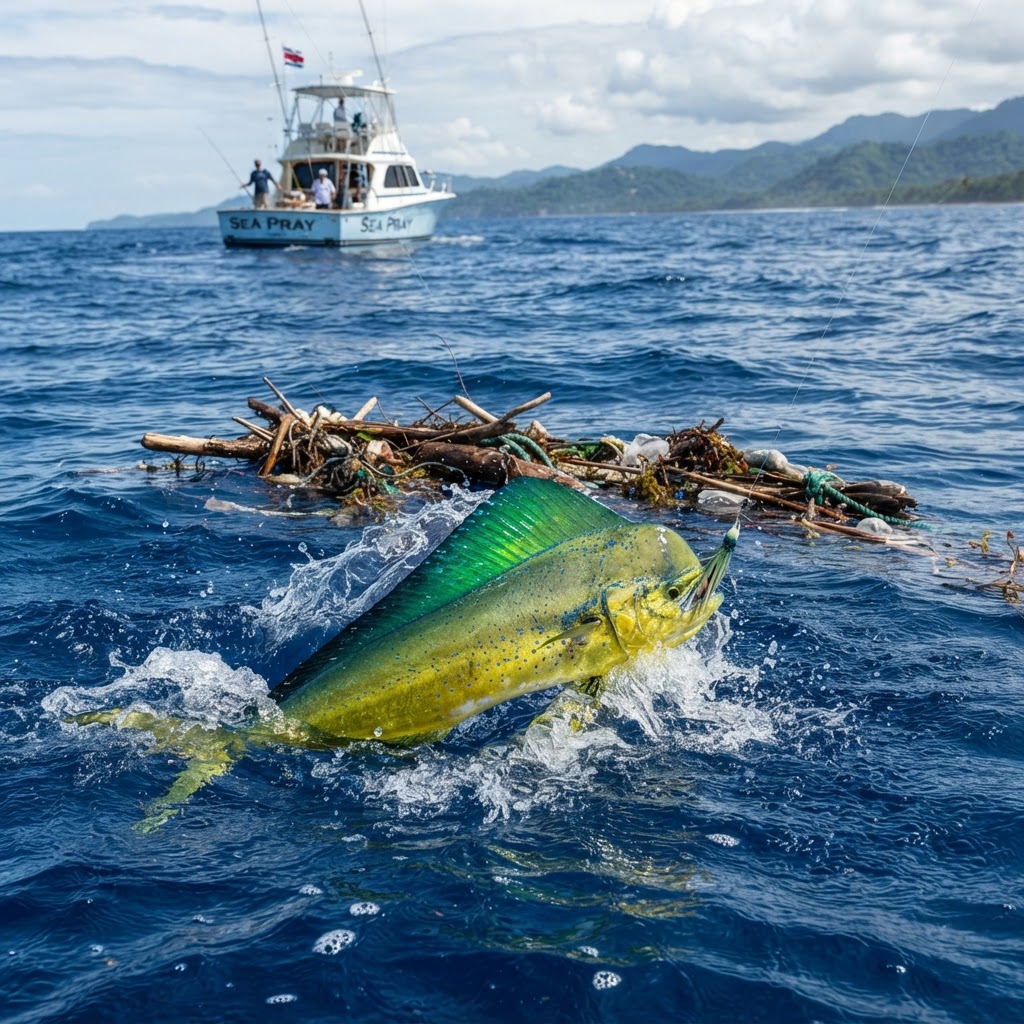
Dorado are strongly associated with floating structure. Logs, branches, weed lines, buoys, and even small pieces of debris can shelter juvenile fish and bait. Captains inspect these objects from a safe distance, watching for flashes of color, birds, or bait movement.
They also hunt along current seams and water-color changes from roughly a few miles offshore to blue water 20 or more miles out. Depth can range from a few hundred to several thousand feet because the floating habitat and food source matter more than the bottom contour.
January
Dry-season blue water can hold dorado around current lines, especially when floating cover is present.
February
Opportunities continue alongside sailfish, though dorado concentrations vary with debris and bait.
March
Mixed offshore spreads may produce dorado while crews search for billfish and tuna.
April
A transitional month with scattered fish near current edges and floating objects.
May
Increasing rain begins washing natural debris offshore and can improve localized habitat.
June
One of the strongest months as current lines, bait, and floating logs become more common.
July
Excellent dorado potential continues, often combined with tuna and marlin opportunities.
August
Productive green-season fishing around debris, weed lines, and color changes remains likely.
September
Dorado are possible, but heavier weather can limit offshore access on some days.
October
Rain continues to move debris offshore; safe weather windows can produce concentrated fish.
November
Conditions begin transitioning, with dorado still available around defined current features.
December
Dry-season weather returns and mixed pelagic trips can include dorado, sailfish, and wahoo.
Fishing Techniques and Tackle
Trolling small skirted lures, feathers, plugs, and rigged ballyhoo is the most efficient way to locate dorado. Once one fish is hooked, the crew may keep it in the water briefly because companions often remain nearby. Other anglers can then cast live bait, small poppers, or jigs to visible fish.
Medium 20- to 30-pound-class conventional or spinning tackle is ideal for most dorado. Fluorocarbon leader and a strong single hook provide a clean presentation. Their aggressive feeding makes them suitable for beginners, but anglers still need to keep steady pressure through repeated jumps.
What to Expect in the Fight
School-size dorado commonly weigh 10 to 25 pounds, while mature bulls can reach 40 to 60 pounds or more. They accelerate quickly, change direction, and leap repeatedly. Many fights last 10 to 25 minutes, though a large fish on light tackle can take longer.
Their bodies are powerful but their mouths can tear if pressure is erratic. Keep the rod loaded, reel smoothly, and avoid giving slack during a jump. Follow the mate's instructions near the boat, where sudden runs are common.
Recommended Charter and Boat
A full-day offshore charter offers the best range to locate moving debris and current lines. Moonwalker, the 33-foot Dawson, combines offshore capability with room for up to six guests, making it a useful choice when several anglers want to cast or rotate through a school of dorado.
Explore Offshore Fishing · View Moonwalker — 33' Dawson
Dorado and Mahi Mahi FAQ
Are dorado and mahi mahi the same fish?
Yes. Dorado, mahi mahi, and dolphinfish are common names for the same species; it is not related to the marine mammal dolphin.
Can we keep dorado to eat?
Legal, appropriately sized dorado may be kept at the captain's discretion. The crew follows current Costa Rican rules and avoids unnecessary harvest.
Why are dorado found near floating debris?
Floating objects create shade and shelter for small fish and other prey, forming a compact food chain that attracts dorado.