Best season
November–March and May–July
Recommended technique
Trolling, teasers and live bait
Costa Rica's Central Pacific coast gives captains access to deep blue water, moving current, and abundant pelagic bait. Marlin are never guaranteed, but a full-day search during a productive seasonal window creates a legitimate opportunity for an unforgettable billfish release.
Where and When to Find Marlin
Marlin may be found 10 to 40 or more miles from Marina Pez Vela, over water from several hundred to thousands of feet deep. They follow food rather than one contour, so captains look for current edges, temperature breaks, seamount influence, floating debris, birds, dolphins, and schools of tuna or bonito.
Some days require covering a broad section of open ocean; on others, one active bait zone holds multiple fish. Satellite information and recent reports help define the search, but the captain's ability to read water color, current, and bird behavior remains essential.
January
A prime dry-season month with blue marlin possible among sailfish, dorado, and tuna.
February
Productive blue water and bait can support marlin, although sailfish often dominate the daily spread.
March
The first major window continues; captains watch temperature breaks and offshore bait concentrations.
April
A transition month with fewer consistent marlin encounters but worthwhile opportunities on favorable water.
May
The second annual marlin window begins as changing currents and tuna activity strengthen offshore.
June
One of the best summer months for blue marlin, often alongside yellowfin tuna and dorado.
July
Marlin remain a primary target around current lines, bait schools, and offshore structure.
August
Fish are possible, but the most consistent summer period normally begins to ease.
September
Variable weather and water conditions make dedicated marlin trips less predictable.
October
A transitional month; captains rely heavily on recent reports and clean-water location.
November
Improving offshore patterns mark the return of a stronger marlin season near Quepos.
December
Dry-season conditions build and blue marlin mix with increasing numbers of sailfish.
Fishing Techniques and Tackle
Trolling lets the boat search efficiently. A marlin spread may combine large hookless teasers, rigged ballyhoo, and skirted lures placed at different distances behind the boat. Heavier 50- to 80-pound-class conventional tackle, durable leaders, and a fighting harness provide control without turning the encounter into an unnecessarily long fight.
When a marlin follows a teaser, the crew may use bait-and-switch: the teaser is pulled away and a circle-hook bait is presented in its place. If tuna or bonito are concentrated, slow-trolled live bait can be extremely effective. Anglers should wait for the mate's instructions before increasing drag or beginning the fight.
What to Expect in the Fight
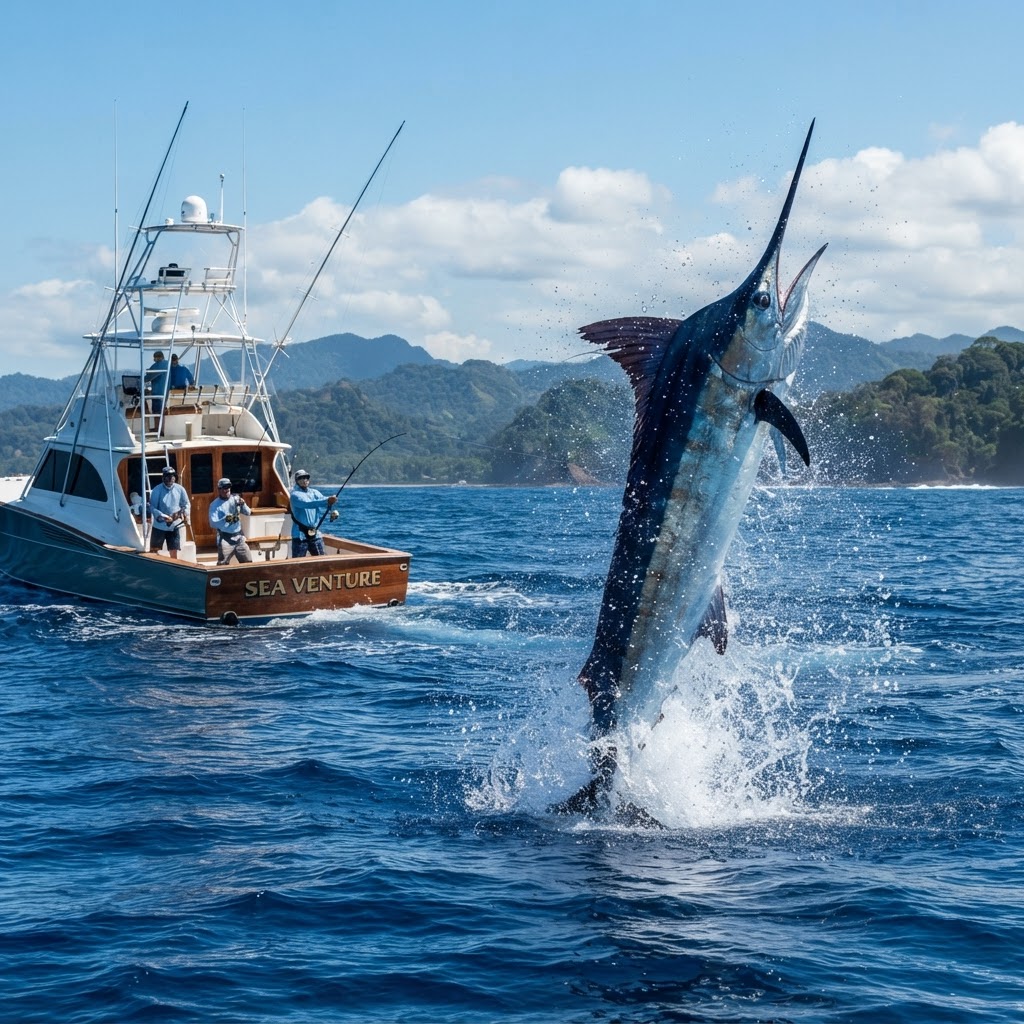
Blue marlin encountered from Quepos commonly range from about 200 to 500 pounds, with larger fish always possible. The opening run can empty line quickly, followed by jumps, deep circles, and sudden changes of direction. A fight may last 30 minutes to more than two hours depending on fish size, tackle, and angler technique.
Smooth pressure and teamwork are more important than brute force. The captain maneuvers the boat while the mate clears lines and coaches the angler. All marlin are released, with circle hooks and efficient handling used to support survival.
Recommended Charter and Boat
A full-day offshore boat with range, shade, heavy tackle, and a spacious working cockpit is recommended. Raven, the 38-foot Bertram Express, is particularly well suited to a dedicated marlin search because its twin-engine offshore platform provides room for a full trolling spread and groups of up to eight guests.
Explore Offshore Fishing · View Raven — 38' Bertram Express
Marlin FAQ
What is the best month for marlin in Quepos?
January through March and May through July are the broadest planning windows, but currents and bait determine the best individual days.
How far offshore are marlin found?
The run often reaches 10 to 40 or more miles. Productive water can move, so a full-day trip gives the captain the necessary range.
Are marlin released?
Yes. ShareFishing crews release billfish and use circle-hook techniques and careful handling to protect the fishery.