Best season
Peak December–April
Recommended technique
Trolling teasers and circle-hook ballyhoo
A sailfish day is highly interactive: crews search, tease fish into the spread, and coach anglers through the bite. Beginners can participate successfully, while experienced anglers appreciate the precision of bait-and-switch technique and light-tackle fighting.
Where and When to Find Sailfish
Sailfish usually roam blue water beyond the coastal shelf, commonly 10 to 30 miles from Quepos over depths ranging from several hundred to several thousand feet. They gather where current edges, temperature changes, birds, and bait create feeding opportunities.
Captains rarely rely on a permanent spot. They watch for flying fish, ballyhoo, small tuna, diving birds, and changes in water color. A productive line can move several miles overnight, making current local knowledge more valuable than an old coordinate.
January
Peak season is established, with stable dry-season weather and strong numbers of Pacific sailfish.
February
Often one of the most consistent months for multiple raised fish and comfortable offshore conditions.
March
Prime sailfish action continues around blue-water edges and concentrated offshore bait.
April
The traditional peak tapers late in the month, though excellent days remain possible.
May
A transition toward marlin, tuna, and dorado; scattered sailfish continue in suitable water.
June
Sailfish are less concentrated but may appear while crews target mixed offshore species.
July
Opportunistic encounters occur around bait and current lines during the productive summer fishery.
August
Mixed-species trips can still produce sailfish, tuna, and dorado on the same day.
September
Weather and current conditions are variable, with fewer dedicated sailfish departures.
October
A transitional month when clean blue water and bait are the main indicators.
November
Numbers begin building as regional currents shift toward the coming dry-season pattern.
December
Peak season returns, particularly as the month progresses and offshore conditions stabilize.
Fishing Techniques and Tackle
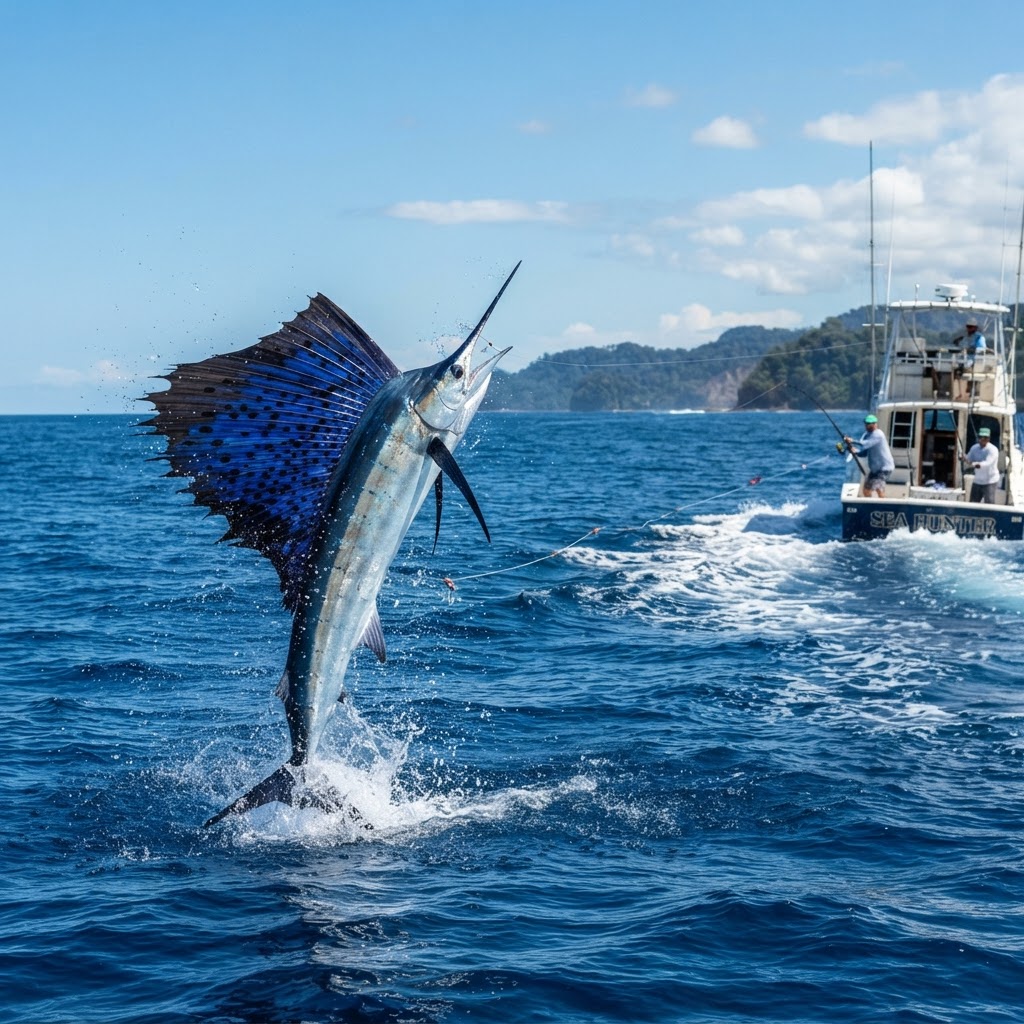
A typical spread combines two to four hookless teasers with several rigged ballyhoo. When a sailfish appears, the mate draws it closer and replaces the teaser with a natural bait carrying a circle hook. The angler allows the fish to eat before smoothly engaging the drag, rather than striking hard.
Twenty- to 30-pound-class conventional tackle keeps the fight sporting while providing enough pressure for an efficient release. Crews may use dredges, daisy chains, and surface teasers to imitate a school of bait. The cockpit must remain organized because several sailfish can enter the spread at once.
What to Expect in the Fight
Most Pacific sailfish near Quepos weigh roughly 70 to 120 pounds, although larger fish occur. They are known for rapid surface runs, headshakes, and repeated jumps. Typical fights last 15 to 40 minutes, depending on tackle, sea conditions, and the angler's ability to recover line.
Keep the rod steady, reel when the fish stops taking line, and move across the cockpit when the mate directs you. Efficient technique reduces exhaustion for both fish and angler and supports a healthy release.
Recommended Charter and Boat
Choose a full-day offshore charter with a professional trolling spread and experienced mate. Cowboy, the 30-foot Bertram Express, is a capable four-person option with a proven diesel platform and the cockpit access needed for teaser fishing. Larger groups can also choose Raven for additional room.
Explore Offshore Fishing · View Cowboy — 30' Bertram Express
Sailfish FAQ
When is sailfish season in Quepos?
December through April is the most consistent period, with January, February, and March usually at the heart of the peak.
Can a beginner catch a sailfish?
Yes. The crew handles the spread and explains the bite, drag, and fighting technique step by step.
Can sailfish be kept?
No. ShareFishing releases sailfish and uses circle hooks and efficient handling to protect this internationally important resource.